Welcome to HITOP FORKLIFT
EN

Language

Language
Save
icon Inquiry cart ( 0 )
News & Events

Spontaneous combustion and explosion-proof of forklift

Views : 966
Author : Hitop
Update time : 2021-06-18 13:47:00
Forklifts are special handling industrial equipment for in-plant operations. While paying attention to logistics operation costs and logistics efficiency, it is also necessary to pay attention to the safe driving of forklifts and the prevention of safety accidents. Among them, the more dangerous accidents include spontaneous combustion, which can be ruled out in advance through necessary protection and investigation.
Classification of forklift spontaneous combustion:

1. the wiring harness problem

If the forklift wiring harness is used for a long time or due to the aging problem due to its service life, when the insulation rubber is broken, the heat dissipation function of the forklift will fail, which will cause spontaneous combustion. In addition, improper modification of the forklift or failure to conduct quality and safety demonstrations after the modification caused the overload of the forklift circuit to cause a short circuit, leading to spontaneous combustion.

2. Engine oil leakage and high temperature problems

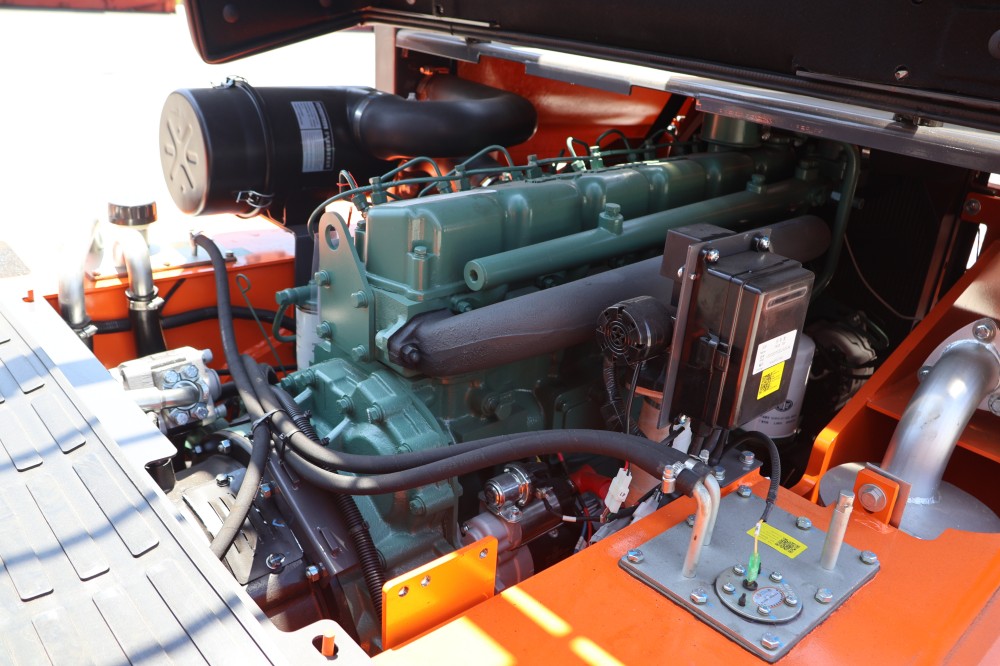
Spontaneous combustion is prone to spontaneous combustion under the influence of several factors such as oil leakage from the fuel pipeline involved in the oil circuit, fuel tank leakage, injection pump, exhaust pipe, etc., high external environment, or working in an inflammable and explosive environment, and poor heat dissipation. The problem also includes the oil stains left on the frame and the forklift engine pipeline that are not cleaned in time after the forklift is repaired and maintained. It is also prone to spontaneous combustion under flammable factors and environmental conditions.

3. Inflammable and explosive materials cause spontaneous combustion

Flammable and explosive environments require explosion-proof modification of forklifts in accordance with safety and environmental management regulations, and safe use of forklifts in strict accordance with national standards for explosion-proof forklifts. In petroleum, chemical, pharmaceutical, paint, paint, coal, national defense and many other industries and units, production, Concentrating, liquefying, and storing and transporting flammable gases; or when producing, filling, releasing, storing and transporting flammable liquids, as well as treating and cleaning objects with these liquids, the flammable gas or dust that may be generated is mixed with air to form an explosive mixture, So that these areas become areas inaccessible to ordinary forklifts. Explosion-proof forklifts are specially designed and produced for places where explosive gas or dust may be generated.
Related News
Read More >>
What to Check When Your New Forklift Arrives What to Check When Your New Forklift Arrives
Sep .18.2026
A new forklift should be inspected before it enters daily service. A structured handover check gives the receiving team a chance to confirm that the truck arrived in the expected condition, that its basic functions work properly, and that the required documents are available.
250-Hour Forklift Maintenance: What to Check After the Second Service Interval 250-Hour Forklift Maintenance: What to Check After the Second Service Interval
Aug .24.2026
A proper 250-hour service is not just an oil change. It is a structured inspection of the forklift's operating condition, lubrication points, mast and chain system, transmission components, brake system, tire condition, and key fasteners. For electric forklifts, it is also the right time to inspect and clean the battery, electrolyte, connectors, and electrical controls.
First 50-Hour Forklift Maintenance: What Should Be Checked After Initial Use First 50-Hour Forklift Maintenance: What Should Be Checked After Initial Use
Aug .20.2026
Learn why the first 50-hour forklift maintenance is important and what should be checked, adjusted, lubricated, or replaced after the initial running-in period.